Most founders have one of two answers. Either "I'll reinvest it" — without knowing exactly where or "I'll keep it in the current account" where it earns nothing and slowly loses value to inflation.
Both are wrong, and for the same reason: neither is a decision. One is a reflex, the other is avoidance.
Here's what the best-run companies in India do differently. TCS, HDFC, Bajaj Finance, Asian Paints they don't wait for cash to show up and then hold a meeting about it. Every rupee of surplus has a pre-decided destination before it arrives. And when you look closely, the destinations are almost always the same five, in almost always the same order.
This is capital allocation. It is the single most important thing a founder does with money, and it is the thing almost no one is taught.
Why "reinvest it" and "keep it in the bank" are both mistakes
Keeping surplus idle in a current account is the easier mistake to see. Current accounts pay nothing. With inflation running in the 4–6% range in India in recent years, cash left untouched for a year loses real purchasing power. A ₹5 crore buffer sitting idle for 24 months isn't "safe" — it's quietly shrinking.
The "reinvest it" reflex is more dangerous because it feels responsible. But reinvestment without a return test is just spending with better branding. Buying a second machine, opening a second location, hiring a bigger team each of these consumes cash today in exchange for a return that may or may not materialise. If that return is lower than what the cash would earn simply sitting in a fixed deposit, you have destroyed value while feeling productive.
The discipline that separates the two outcomes is a hierarchy. Not a mood. A hierarchy.
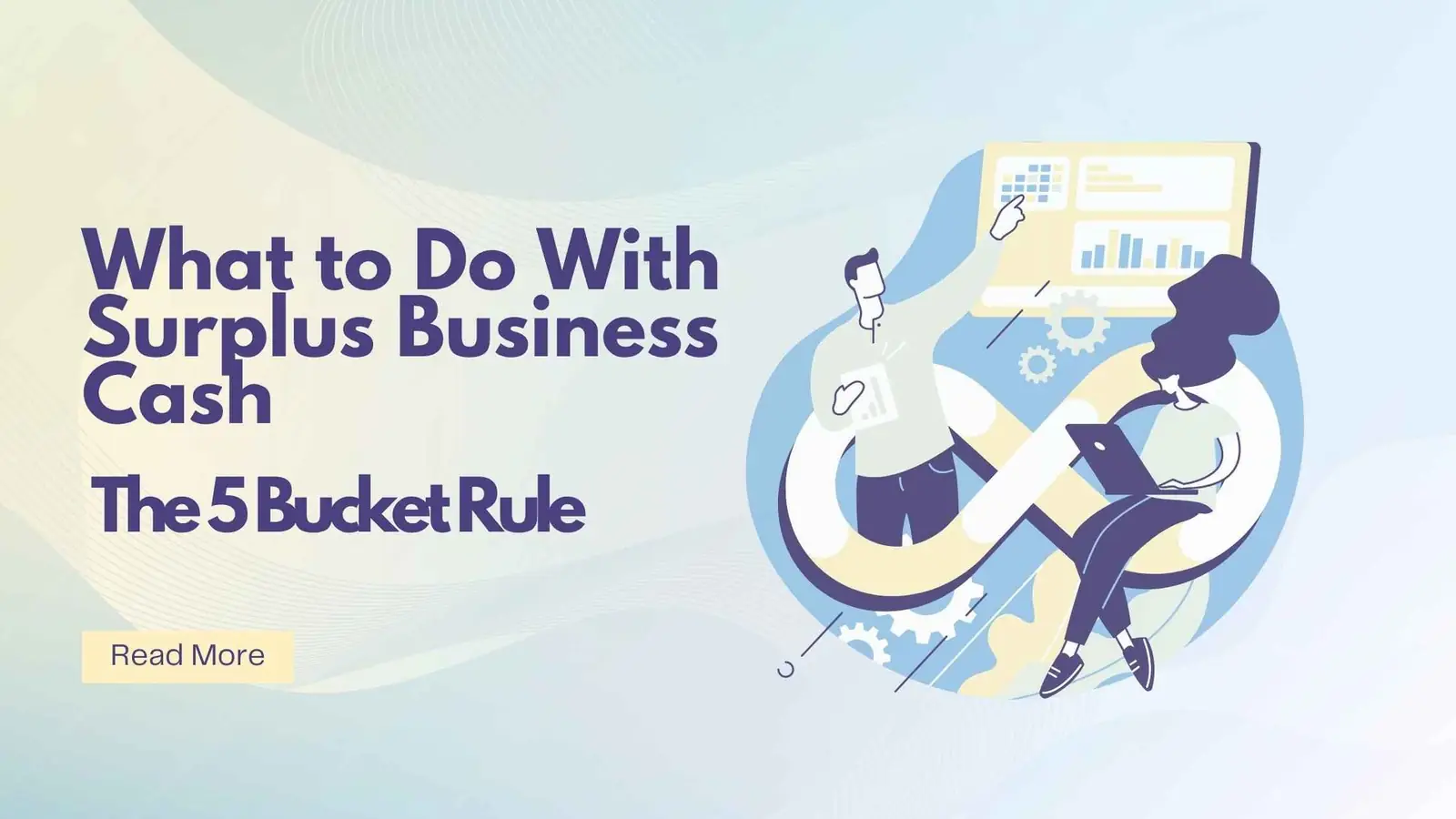
The 5-bucket capital allocation framework
Here is the order that shows up, again and again, inside disciplined businesses. Each bucket must be satisfied before you move to the next.
| Bucket | Purpose | The question it answers |
|---|---|---|
| 1. Protect the business | Build a cash buffer | Can we survive a bad quarter without borrowing? |
| 2. Pay down expensive debt | Clear high-cost borrowings | Is any rupee of debt costing more than we can safely earn? |
| 3. Reinvest in the business | Capex, R&D, people | Will this earn more than our cost of capital? |
| 4. Acquire or partner | Inorganic growth | Is buying faster and cheaper than building? |
| 5. Return to owners | Dividends, withdrawals | Have the first four buckets been genuinely satisfied? |
Bucket 1 — Protect the business
Before anything grows, the business has to be able to survive. A cash buffer is not idle money; it is insurance against the month a large customer pays 60 days late, a machine breaks, or a season underperforms. A common working target is enough liquid cash to cover 3–6 months of fixed operating costs, though the right figure depends on how lumpy your receivables are and how concentrated your customers are.
If a single customer is 40% of your revenue, your buffer needs to be larger, because your downside is larger.
Bucket 2 — Pay down expensive debt
Clearing a working-capital loan or an OD facility that costs you 12–14% is a guaranteed return of 12–14%. There is almost no reinvestment in an ordinary MSME that reliably beats a guaranteed, risk-free 12–14%. Yet founders routinely leave expensive debt untouched while chasing a new project whose returns are uncertain.
Rule of thumb: if the interest rate on a debt is higher than the return you can confidently earn on a new investment, clear the debt first. It is the cleanest rupee you will ever deploy.
Bucket 3 — Reinvest in the business
Only now does expansion make sense — and only when it passes the return test. Before committing to capex, R&D, or a hiring wave, force the question: what return will this generate, and is it higher than our cost of capital? If your cost of capital is roughly 12–15% and a project can't credibly clear that hurdle, it doesn't belong in Bucket 3. It belongs on the shelf.
Bucket 4 — Acquire or partner for growth
For businesses with genuine scale and a strong balance sheet, buying a competitor, a supplier, or a capability can be faster and cheaper than building it. This bucket is where most MSMEs are not yet ready to play — and that's fine. Skipping it is a valid choice; pretending it doesn't exist is not.
Bucket 5 — Return to owners
Dividends and founder withdrawals are legitimate — after the first four buckets are handled. The problem isn't taking money out. The problem is taking it out of Bucket 5 while Buckets 1 and 2 are still empty, which is exactly what happens when a founder pulls surplus before building a buffer or clearing costly debt.
The mistake almost every MSME makes
Most MSMEs skip straight to Bucket 3 or Bucket 5. They either immediately spend the surplus on expansion, or the founder takes it out. Nobody pauses to ask the three questions that the hierarchy forces:
- Do we have enough buffer to survive a bad quarter?
- Is there expensive debt we should clear first?
- Will this reinvestment actually earn more than its cost?
Skipping these questions is why two businesses with identical profits can end up in completely different places three years later. One compounded its surplus through a disciplined hierarchy. The other sprayed it at whatever felt urgent that quarter.
Case Study - Two ₹5 crore surplus business
Consider two manufacturers, each ending the year with ₹5 crore of surplus cash.
Sharma Industries withdraws ₹2 crore as a dividend and puts ₹3 crore into a new production line, because demand "feels strong." No buffer is built. A ₹1.5 crore working-capital loan at 13% is left running. Eight months later a key customer delays payment, the buffer that doesn't exist is badly missed, and the company borrows more at a higher rate to make payroll.
Verma Manufacturing runs the hierarchy. ₹1.5 crore goes to a buffer (Bucket 1). ₹1.5 crore clears the 13% loan, locking in a guaranteed 13% return (Bucket 2). The remaining ₹2 crore funds the new line — but only after confirming it clears a 15% return hurdle (Bucket 3). No dividend this year, because the first buckets came first.
Same profit. Same industry. One is compounding; the other is firefighting. The difference wasn't revenue. It was the order in which the cash was deployed.
How Jordensky helps
Capital allocation is exactly the kind of decision that gets postponed because no one in the business owns it. The accountant records what happened; the founder is too close to the day-to-day to run the hierarchy dispassionately. As your outsourced CFO, Jordensky builds the buffer target, quantifies your true cost of capital, sets return hurdles for reinvestment, and turns "where should this surplus go?" from an annual guess into a repeatable rule.
If your business is generating surplus and you're deciding it one project at a time, that's the signal it's time for a CFO-level allocation framework.
Frequently asked questions
Q1 - What is capital allocation for a business?
Capital allocation is the process of deciding where a business's surplus cash goes buffer, debt repayment, reinvestment, acquisitions, or owner returns. Done well, it follows a pre-decided hierarchy rather than being decided reactively each time cash arrives.
Q2 - How much cash buffer should a business keep?
A common target is enough liquid cash to cover 3–6 months of fixed operating costs. Businesses with concentrated customers, lumpy receivables, or seasonal revenue should hold more, because their downside is larger.
Q3 - Should I pay off business debt or reinvest surplus cash?
If the interest rate on your debt is higher than the return you can confidently earn on a new investment, clear the debt first. Paying off a 13% loan is a guaranteed 13% return — hard to beat with an uncertain project.
Q4 - Is it wrong for a founder to withdraw profit?
No. Owner returns are a legitimate use of surplus. It only becomes a problem when withdrawals happen before the business has a buffer and before expensive debt is cleared.
Q5 - What return should a reinvestment earn to be worth it?
At minimum, more than your cost of capital — often in the 12–15% range for Indian MSMEs. If a project can't credibly clear that hurdle, the cash is usually better used clearing debt or building the buffer.
Q6 - Does a small business really need a capital allocation framework?
Any business generating meaningful surplus benefits from one. The framework doesn't require scale — it requires discipline. The absence of one is what causes profitable businesses to feel perpetually short of cash.
This article is general information for business owners, not investment, tax, or financial advice. Deployment of surplus cash depends on your specific balance sheet, tax position, and risk profile. Consult a qualified professional before acting.